

Introduction: Why Climate Matters to Me
Living in Nigeria, I’ve realized that when people talk about climate change, it often feels distant and vague. You’ll hear phrases like “the climate is changing” or “global warming is real”, but ask the average person what that actually means in terms of their daily life, and many simply don’t know. I don’t blame them. For years, climate change was treated as something abstract, happening elsewhere, maybe in the polar regions or in distant developed nations.
But the truth is, it’s happening right here, in our communities, in Nigeria, in Africa. The rising heat, flooding, desertification, erratic rainfall, and even the public health challenges we face, these are all climate-linked realities. I personally treat malaria and typhoid several times a year, and I know these diseases are worsened by poor sanitation, stagnant water, and the broader effects of a changing environment.
This is why the climate feature on Kaci Help means so much to me. It’s not just another app tool, it’s a way for us, ordinary people, to understand our role in climate change, track it in a practical way, and most importantly, take action.
Why I Added the Climate Feature to Kaci Help
When I started working on Kaci, my dream was to create a platform that goes beyond emergencies, beyond alerts, and beyond daily updates. I wanted it to be a tool that educates, empowers, and inspires people to live responsibly. And nothing represents that more than climate.
But I didn’t want climate information to be another lecture or intimidating graph. I wanted it to be something relatable, measurable, and engaging, something that could help each person see their daily impact and decide what they could do better. That’s why I created the Climate Feature, built around simple questions divided into four sections: Home, Food, Utilities, and Travel. These are things we all deal with every single day.
Getting Started: Signing Up and Setting Up
Using Kaci Help is simple. First, you sign up with your active phone number and get verified through WhatsApp, SMS, or email. Once you’re in, you go to your Profile page to edit and complete your details.
From there, the Climate Feature is just a click away on the homepage. Once you click the button, you land on a welcome page that starts with a Read More link. This link is not optional, it’s an invitation. It gives you a crash course on climate change, explaining emissions, CO2 usage, and why your answers matter. It’s where I break down those big, confusing climate terms into simple, human language.
The Four Sections of Climate Tracking
1. Home
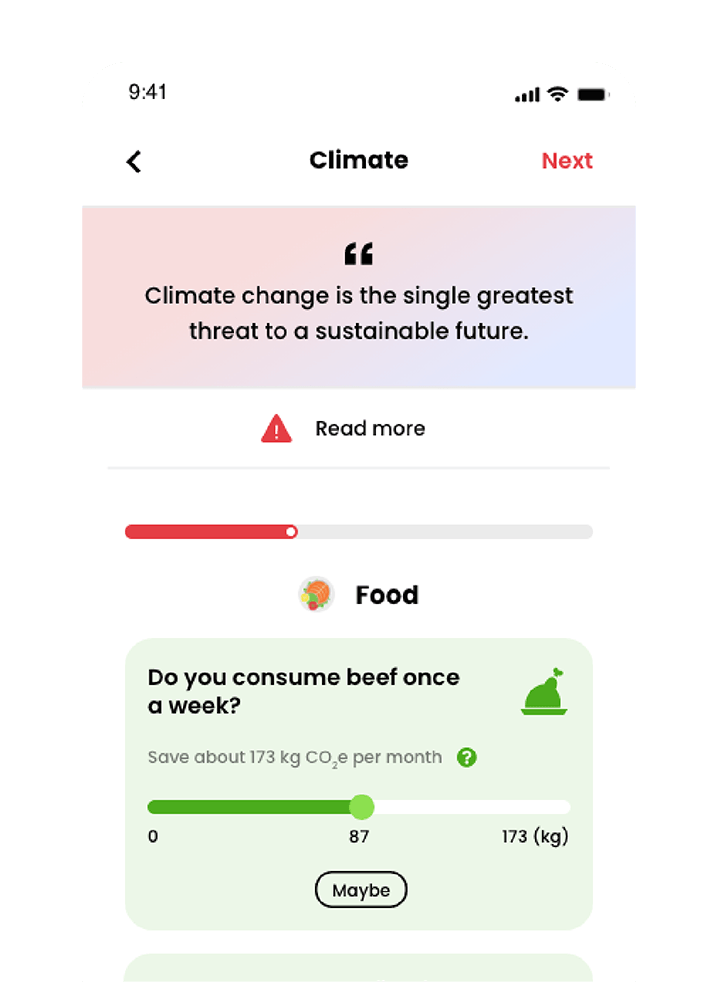
The first section is Home. Here, you’ll see practical questions that connect climate to the place where you live. For example:
-
“Have you insulated your roof, walls, windows, and floors?”
Subtext: Save about 133 kg CO2e per month.
This isn’t just a question—it’s a challenge. With the question mark icon next to it, you can read more about what it means and why it matters. The response system is also interactive. You drag a circle along a line from 0 (Kg) to 133 (Kg). The line is divided into three parts:
-
From 0 to the middle means No,
-
The middle means Maybe,
-
From middle to the far end means Yes.
This design makes it easy and fun, but also powerful. You get to see your potential CO2 impact in real numbers.
2. Food
Next is Food. Every meal we eat has a footprint. From the way it’s grown to the way it’s cooked, our choices matter. Here you’ll find questions about your diet, food sources, and habits. Do you eat more plant-based meals? Do you cut down on food waste? Each answer reveals the kilograms of CO2 tied to your food lifestyle.
3. Utilities
The Utilities section is where daily living really shows its climate weight. Electricity, water heating, appliances, and more—all of these add up. Here, users answer questions that reveal how much energy they consume and whether they use cleaner alternatives like solar. I personally use solar panels in my home, and it has helped me reduce my footprint significantly while saving money in the long run.
4. Travel
Finally, there’s Travel. Transport is a huge emitter worldwide, and Nigeria is no exception. The feature asks you about your daily commute, car type, and whether you use public transport or walk when possible. For instance, if you drive a petrol car daily, your emissions will be higher than if you use CNG (compressed natural gas) or carpool.
Each of these sections ends with a Next button, guiding you step by step until you’ve answered as many (or as few) questions as you like. And remember, all questions are optional. You’re free to answer what applies to you.
The Result Page: Where It All Comes Together
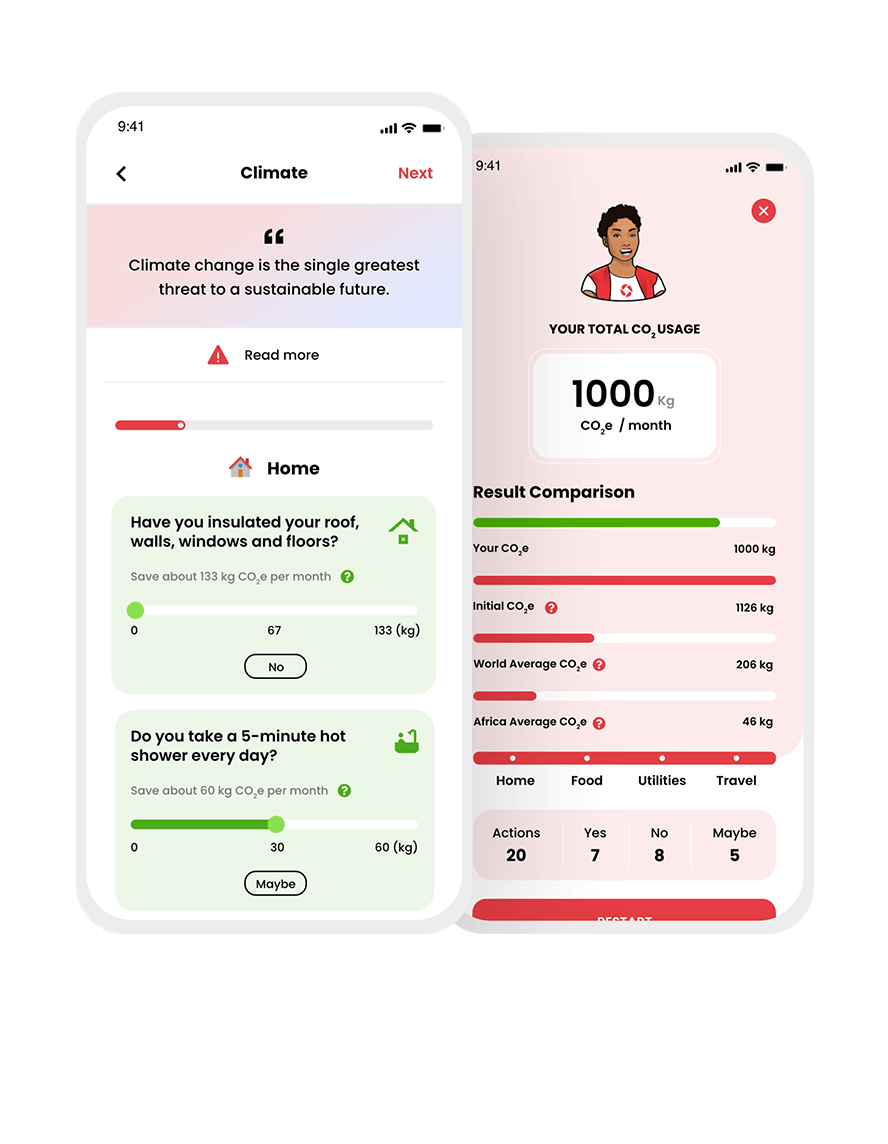
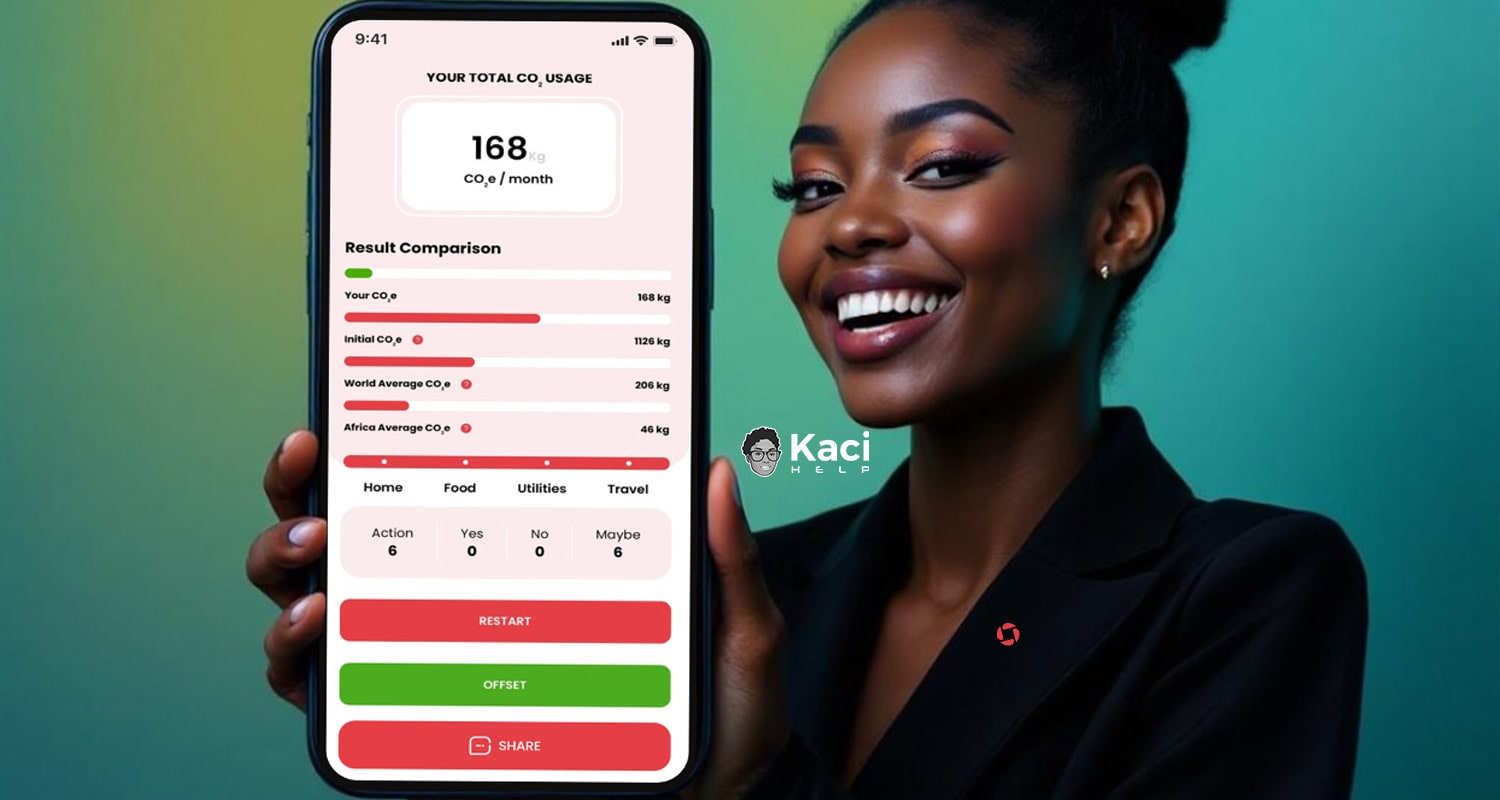
After you’ve completed the four sections, you click Submit, and this is where the magic happens.
On the Result Page, you’ll see:
-
Your Total CO2 Usage: calculated based on only the questions you answered.
-
Result Comparison: showing how your footprint compares with:
-
The total CO2e of all questions,
-
The world average CO2e,
-
The Africa average CO2e.
-
This gives you perspective. Suddenly, you’re not just an individual in isolation—you’re part of a bigger picture. You can see where you stand and where you can improve.
The Action Table then breaks down your answers into Yes, No, and Maybe, helping you clearly see areas where you’re already doing well and where you could change.
And finally, the feature gives you four buttons:
-
Restart: to retake the questions.
-
Offset: this is one of my favourites. When you click Offset, you’re redirected to Kaci Help Projects. Here, we showcase initiatives like tree planting, production of cookstoves in IDP camps, and solar concentrator projects. You can contribute to these projects as a way to balance or “offset” the emissions you create. Offsetting is about responsibility, it’s about acknowledging your footprint and supporting actions that reduce or absorb carbon elsewhere.
-
Share: this lets you share your result with others in your country. Imagine the power of people posting their CO2 usage, sparking conversations and friendly challenges.
-
Close: which simply takes you back to the homepage.
Why This Matters
The climate crisis is not someone else’s problem. It’s ours. In Nigeria, climate impacts are already threatening our food systems, our water resources, and our health. But instead of waiting for government policies or international aid, we can start with ourselves.
That’s what the Kaci Climate Feature is about, empowerment. It’s not here to guilt-trip you. It’s here to give you knowledge, perspective, and action points.
I’ve spent five years working full-time on Kaci, pouring everything I have into it. It has drained me at times, but features like this remind me why I started. Because if even one person changes a habit, offsets their emissions, or teaches their family about CO2 through Kaci, then I know the work is worth it.
A Personal Encouragement
To you reading this: climate change may feel overwhelming, but it begins with awareness. By using the Kaci Climate Feature, you’re not just answering questions, you’re taking a stand. Every “Yes,” every “Maybe,” every click toward Offset is a step toward protecting our planet and our future.
Nigeria is my home, and I believe in staying here to solve our problems rather than running away from them. Climate change is one of those problems. Together, we can make it less abstract, more measurable, and more actionable.
So, I encourage you: download the Kaci app, explore the Climate Feature, answer the questions honestly, and share your results. Let’s create a culture where we track, compare, and offset, not just for ourselves, but for our children and generations yet unborn.
Because at the end of the day, fighting climate change is not about numbers. It’s about life, community, and hope. And hope, when turned into action, is the most powerful thing we have.